
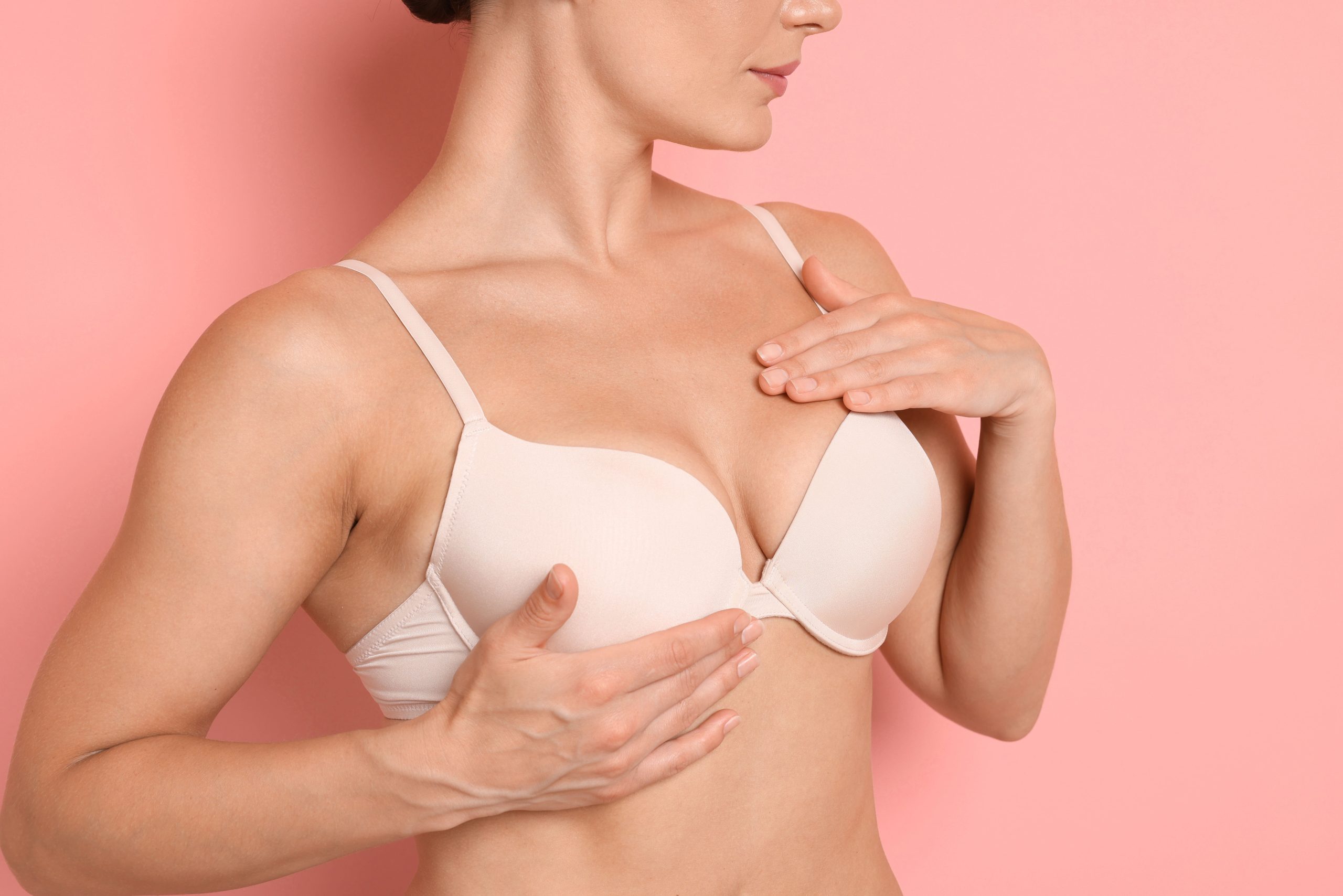

Breast augmentation can restore lost volume, correct asymmetry, and address developmental concerns. The procedure involves placing implants or transferring fat to increase breast size, improve shape, or restore volume lost due to weight changes, pregnancy, or ageing. The outcome depends entirely on matching the right surgical technique to individual anatomy.
The key is not simply choosing a bigger cup size, but selecting an approach that matches your chest width, breast tissue, skin quality, lifestyle, and aesthetic goals.
Breast augmentation may be performed using silicone implants, fat grafting, or a combination of both. Silicone implants remain the most common choice when a more predictable increase in breast volume is desired, while fat grafting may suit patients seeking a modest, natural enhancement using their own tissue. In selected patients, 3D simulation can also help visualise how different implant sizes and profiles may look on their frames.
Restoring Volume After Pregnancy and Breastfeeding
Pregnancy and breastfeeding cause significant changes to breast tissue that often don’t reverse naturally. During pregnancy, hormonal shifts cause breast tissue to expand and milk ducts to develop. After breastfeeding ends, the glandular tissue shrinks. However, the stretched skin may not contract proportionally, leaving the breasts appearing deflated or droopy.
Many women describe their post-breastfeeding breasts as having lost upper-pole fullness—the rounded appearance in the upper portion of the breast. This change occurs because the breast tissue has shifted downward, whilst the stretched skin envelope remains stretched. The nipple position may also appear lower relative to the breast fold.
Breast augmentation can restore this lost volume. However, women with significant sagging may need a combined procedure with a breast lift. Surgeons typically recommend waiting at least several months after completing breastfeeding to allow breast tissue to stabilise before assessing what correction is needed.
Correcting Natural Breast Asymmetry
Breast asymmetry is common in most women. However, noticeable differences in size, shape, or position can cause significant self-consciousness. Asymmetry may be present from puberty or develop later due to hormonal changes, weight fluctuations, or conditions affecting chest wall development.
Common asymmetry patterns include:
- One breast is noticeably larger than the other
- Differences in nipple position or areola size
- Variations in breast shape, where one may be more tubular whilst the other is rounder
In some cases, asymmetry results from conditions like Poland syndrome — a rare congenital condition estimated to affect approximately 1 in 30,000 people, in which the pectoralis major muscle is partially or completely absent on one side. This is typically accompanied by underdevelopment of breast tissue and, in some cases, the rib cage, subcutaneous fat, or upper limb on the same side.
Surgical correction of Poland syndrome-related asymmetry is complex and usually requires individualised planning, often including implant placement, fat grafting, or chest wall reconstruction.
Correcting asymmetry often requires different approaches for each breast. A surgeon might use different implant sizes, place implants at different positions, or combine augmentation on one side with a lift or reduction on the other. The goal is to achieve visual symmetry in clothing and improved proportional balance.
Addressing Developmental Concerns
Some women never develop breast tissue to the extent they expected during puberty. This can result from hormonal factors, genetic predisposition, or conditions like tuberous breast deformity, where breast tissue doesn’t spread normally across the chest wall during development.
Tuberous breasts have a characteristic appearance: a narrow base, higher-than-normal breast fold, and tissue that herniates into an enlarged areola (the darker skin surrounding the nipple). This is a congenital condition that becomes apparent during puberty, when a thickened fibrous ring at the breast base restricts normal breast expansion in both the horizontal and vertical dimensions. Rather than spreading outward across the chest wall, the tissue herniates into the nipple-areola complex, causing the characteristic puffy, enlarged areola.
Women with micromastia — a condition referring to postpubertal underdevelopment of breast tissue, for which there is no single objective size threshold — may find that their chest appears disproportionate to their frame.
Rebuilding After Weight Loss
Significant weight loss, whether through lifestyle changes or bariatric surgery, often affects breast appearance dramatically. Breasts are composed of fatty (adipose) tissue, glandular tissue, and fibrous connective tissue. Fatty tissue typically constitutes the majority of breast volume, so significant weight loss tends to reduce breast size — though glandular volume may also decrease to a lesser degree.
Women who have lost substantial weight frequently describe their breasts as empty, with excess skin and minimal remaining tissue. The degree of breast deflation depends on factors including age, skin elasticity, how much weight was lost, and how quickly the loss occurred.
For post-weight-loss patients, breast augmentation alone may not achieve desired results if significant excess skin exists. A breast lift combined with implant placement addresses both volume loss and skin excess. Your doctor can discuss whether this approach might be suitable for your situation. Some surgeons recommend staging these procedures separately, whilst others perform them together depending on individual circumstances.
Achieving Proportional Balance
Body proportions vary naturally. Some women feel their breast size doesn’t balance with their hip width, shoulder breadth, or overall frame. This proportional concern isn’t about achieving a specific cup size but about creating visual harmony.
Women with athletic builds sometimes find that muscle development in their chest area doesn’t translate to breast fullness. Others may have naturally wider hips that make their chest appear comparatively small. Some women simply feel their current breast size doesn’t match the mental image of their ideal proportions.
During consultation, surgeons assess the patient’s existing chest wall dimensions, tissue characteristics, and body frame. They recommend implant sizes that would create natural-looking proportions. Using too large an implant relative to the chest wall can create an artificial appearance, whilst appropriate sizing integrates naturally with the patient’s anatomy.
Types of Breast Implants Available
In Singapore, many patients considering breast augmentation will discuss silicone gel implants such as Motiva or Mentor. Motiva implants are known for their SmoothSilk surface and Ergonomix design, which aims to provide a soft, natural feel and movement. Mentor implants have a long track record and offer a broad range of silicone gel options, profiles, and projections. The choice is not simply about brand; it depends on chest width, soft tissue coverage, desired shape, implant feel, and the surgeon’s assessment of what your tissues can safely support.
Motiva Preservé is a newer tissue-preserving technique using Motiva implants, designed for selected patients where a more conservative pocket creation approach is suitable. It is not appropriate for every patient, every implant size, or every revision case.
Implants also come in different shapes: round or anatomical (teardrop). Round implants provide more upper pole fullness, whilst anatomical implants have more projection at the bottom, mimicking natural breast shape. The choice depends on the patient’s anatomy and desired outcome.
Implant Placement Options
Surgeons can position implants either above the chest muscle (subglandular placement) or partially beneath it (submuscular or dual-plane placement). Each approach offers different advantages.
Subglandular placement: Positions the implant between the breast tissue and the pectoral muscle. This placement offers faster recovery, less post-operative discomfort, and may be preferred for patients with adequate breast tissue coverage. However, implant edges may be more visible in thin patients.
Dualplane placement: Many modern breast augmentations use a dual-plane approach, where the upper part of the implant is covered by the pectoralis muscle while the lower part sits beneath the breast tissue. This can provide better upper-pole coverage in thinner patients while allowing the lower breast to expand more naturally.
Incision location varies by implant type. Saline implants — filled after placement — offer the greatest flexibility, including the inframammary fold, periareolar border, or transaxillary (armpit) approach. Silicone implants are most commonly placed via the inframammary or, in some cases, the periareolar or transaxillary approach, depending on implant size and surgeon preference. Many surgeons prefer the inframammary approach for direct access and control during placement, regardless of implant type.
What the Consultation Process Involves
Initial consultation establishes whether breast augmentation aligns with the patient’s goals and whether they’re suitable candidates. The surgeon reviews medical history, examines breast tissue and chest wall anatomy, and discusses expectations in detail.
Measurements taken during examination include:
- Chest width
- Existing breast dimensions
- Skin quality assessment
- Nipple position
These measurements guide implant size and placement recommendations. Many surgeons use sizing systems or imaging software to help patients visualise potential results with different implant options.
The consultation also covers realistic outcome expectations. Breast augmentation changes size and can improve shape. However, factors like natural tissue quality, chest wall shape, and skin elasticity affect the final result. Understanding limitations helps ensure satisfaction with outcomes.
Recovery Timeline and Expectations
Recovery depends on implant size, pocket choice, surgical technique, pain threshold, and the patient’s usual activity level. A patient having a modest implant above the muscle may recover differently from someone having a larger dual-plane augmentation. Initial swelling and discomfort are most pronounced during the first few days. In most cases, patients manage discomfort adequately with prescribed pain medication during this period.
During the first week, patients typically need assistance with daily activities. They should avoid lifting anything heavy. Surgical bras or compression garments support healing and help implants settle into position. Light walking is encouraged to promote circulation, but strenuous activity is restricted.
In a few weeks, most patients return to desk jobs and light daily activities. Swelling continues to decrease gradually over several months. Final results typically stabilise over 3 to 6 months as implants settle and swelling fully resolves. Scars mature over time, gradually fading from pink to less noticeable lines over several months to a year.
Potential Risks and Complications
All surgical procedures carry risks. Breast augmentation-specific complications include:
Capsular contracture occurs when scar tissue around the implant tightens excessively. This causes firmness, discomfort, or shape distortion. It remains a common reason for revision surgery.
Implant rupture or deflation may occur from trauma, normal wear over time, or manufacturing defects. Saline ruptures are immediately apparent. Silicone ruptures may require imaging for detection.
Changes in nipple sensation either increased or decreased sensitivity, are common in the early post-operative period, with studies reporting temporary changes in approximately 50% of patients. Most sensation changes resolve within 2 to 3 months, though some patients take up to 1 to 2 years to recover sensation. Permanent changes are uncommon but are a recognised risk that should be discussed with your surgeon.
Implant malposition includes complications such as bottoming out (implant descending below the natural breast fold), symmastia (medial displacement of one or both implants beyond the midline, causing loss of the natural separation between the breasts and detachment of skin from the sternum), or lateral displacement (implants shifting too far toward the armpits). These may require revision surgery for correction.
When to Seek Professional Help
- Sudden significant size change in one breast
- Fever or any increasing redness, warmth, or pus-like drainage around incision sites — these are signs of possible infection and warrant prompt contact with your surgeon, not a watch-and-wait approach.
- Severe pain not controlled by prescribed medication
- Unusual hardness developing in one or both breasts
- Noticeable implant shape change or asymmetry developing over time
- Any concerns about healing or results during recovery
Commonly Asked Questions
How do I choose the right implant size?
Implant size selection involves matching your anatomical measurements with your goals. Your surgeon will assess your chest width, existing tissue, and skin elasticity to determine what sizes would look proportional. Many practices offer sizing consultations with temporary sizers to help you visualise different options before surgery.
Will breast implants affect breastfeeding?
Most women with implants can breastfeed successfully. Implant placement beneath the muscle and incisions in the breast fold or armpit typically preserve milk ducts and nerves relevant to breastfeeding. Many women with periareolar incisions do breastfeed successfully, but the risk is not trivial and should be discussed with a surgeon before choosing an incision type.
How long until I can exercise after surgery?
Light walking is encouraged within the first 24–48 hours to reduce clot risk. Most patients can return to lower-body and light cardio exercise around weeks 2–3, with surgeon clearance. Upper-body work and chest exercises are typically restricted until weeks 4–6, and high-impact activities or weightlifting generally require explicit clearance at the 6–8 week mark. Placement type (above vs below the muscle) significantly affects this timeline — submuscular placement involves the pectoral muscle and typically requires a longer restriction period.
Do implants need to be replaced eventually?
Implants aren’t lifetime devices, though they don’t have strict expiration dates. Some women keep their original implants for many years without issues. Others may need replacement sooner due to complications or a desire for size changes. Regular monitoring through physical examination and imaging when indicated helps identify any changes requiring attention.
What’s the difference between breast augmentation and a breast lift?
Augmentation increases breast size using implants or fat transfer. A lift (mastopexy) raises and reshapes sagging breasts by removing excess skin and repositioning the nipple-areola complex to a higher position on the chest.
When Breast Augmentation Alone May Not Be Enough
Breast implants can restore volume, but they do not reliably correct significant sagging. If the nipple sits low, the breast envelope is stretched, or there is substantial excess skin after pregnancy or weight loss, a breast lift may be required. In some patients, the best result comes from combining a lift with implants; in others, a staged approach may be safer or more predictable.
Next Steps
A breast augmentation consultation should clarify not only what size you want, but what your tissues can safely and naturally support. If you are considering breast augmentation in Singapore, a detailed assessment can help determine whether implants, fat grafting, a breast lift, or a combination approach is most suitable for your anatomy and goals.
Choosing the right approach requires a physical assessment. If you are considering this procedure, the next step is to consult a Ministry of Health-accredited plastic surgeon in Singapore.
If you are experiencing post-pregnancy volume loss, noticeable breast asymmetry, or developmental concerns such as tuberous breast deformity or micromastia, consult with a plastic surgeon to determine the appropriate implant type, placement, and surgical approach for your anatomy.
